
PVC film, painted, solid wood or melamine: which finish for cabinet doors and furniture?
Kitchen cabinets, wardrobes and furniture are usually finished in one of four ways: painted (lacquered) MDF, solid wood, melamine-faced board, or MDF covered with PVC decorative film, also called thermofoil. Each has its place, and many cabinets combine two of them. Here is how they compare for door and cabinet makers and for the people who buy their furniture.
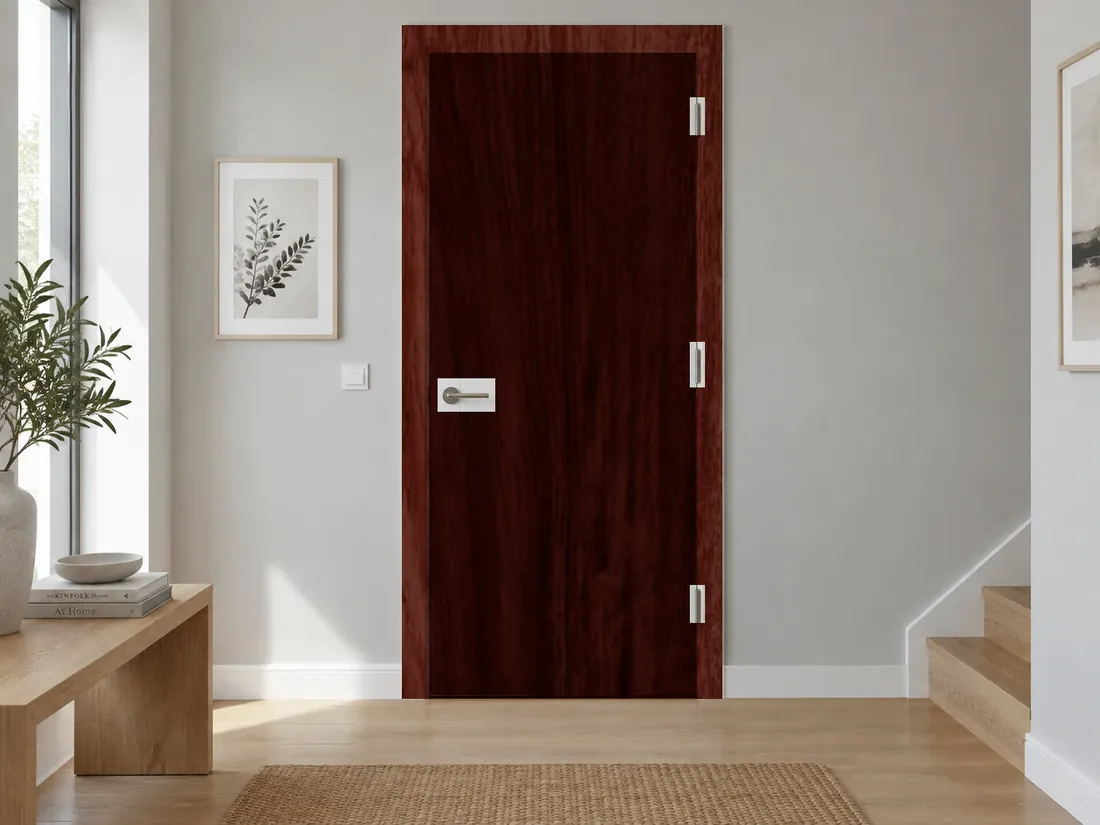
Xingpai makes decorative film only. We supply PVC, PET and PP film in rolls to door, cabinet and panel makers, who press or laminate it on their own machines. We do not make melamine boards, and we do not make doors or furniture.
How each finish is made
- Painted (lacquered) MDF: the MDF door is routed, then primed and sprayed with several coats of paint or lacquer, with sanding and drying between coats.
- Solid wood: the door is made from solid timber, usually a frame with a panel, then stained and lacquered.
- Melamine board: decorative paper soaked in melamine resin is hot-pressed onto particle board or MDF at a board factory. Furniture makers buy the finished boards, cut them to size and cover the cut edges with edge banding.
- PVC film: the routed MDF door is sprayed with adhesive and covered with PVC film in a vacuum membrane press, so the face, the edges and the routed profile are finished in one step. Flat panels are covered by flat lamination. How the processes work →
Side-by-side comparison
| Painted MDF | Solid wood | Melamine board | PVC film on MDF | |
|---|---|---|---|---|
| Shapes | Routed doors and flat panels | Frame-and-panel doors, carved shapes | Flat panels only; cut edges are banded, so the seam shows | Routed doors with face and edges covered in one piece; flat panels too |
| Look | Any solid color, from matte to high gloss | Natural grain; every piece is different | Mostly wood grain and solid colors; textured surfaces available | Wood grain, solid colors, stone and marble, fabric and leather textures, high gloss, soft touch |
| Same look on every door | Depends on paint mixing and spraying; touch-ups can show | Natural variation in color and grain | Printed paper, so the boards look the same | Printed film, so every door in the order looks the same |
| Wood look | No grain | Real wood | Printed wood grain | Printed wood grain; with embossed in register (EIR) film the texture follows the grain |
| Moisture | Good when fully sealed; chips let moisture into the MDF | Wood swells and shrinks with humidity and can crack or warp | The face resists water; the edges depend on the edge banding | The film does not absorb water and wipes clean; on pressed doors the face and edges are one piece |
| Heat | Handles normal kitchen use | Handles normal kitchen use | Handles normal kitchen use | Avoid long, direct heat, for example next to ovens; use heat shields there |
| Wear | Edges can chip | Dents, but can be sanded | Hard surface that resists scratches | Depends on the film; scratch-resistant series are available |
| Repair | Can be touched up or repainted | Can be sanded and refinished | Hard to repair; the panel is usually replaced | Hard to repair; the door is usually replaced |
| Production | Many steps: priming, sanding, several coats, drying | Joinery and finishing; skilled work | Cut and edge-band ready-made boards | One pressing step after routing |
| Cost | Medium to high, rising with coats and gloss | Usually the highest | Usually the lowest, for flat panels | Higher than melamine for flat panels; usually lower than paint or solid wood |
Melamine and PVC film often work together
Melamine board and PVC film are not always competitors. A common kitchen or wardrobe uses melamine board for the cabinet body and shelves, where flat, low-cost panels are enough, and PVC film for the doors, where buyers want a shaped door, edges without seams, or a high gloss, soft-touch or textured surface. Please note again: Xingpai does not make melamine boards. We make the decorative film.
Which one should you choose?
Painted MDF
- You want a solid color with a seamless, smooth face
- You want to be able to touch up or repaint later
- The budget allows for a multi-coat finish
Solid wood
- You want real wood and its natural variation
- You want furniture that can be sanded and refinished
- Price is less important than the material itself
Melamine board
- You need flat panels at the lowest cost
- The parts are cabinet bodies, shelves or plain flat doors
- A hard, scratch-resistant surface matters more than shape
PVC film
- You want shaped doors with the face and edges in one piece
- You want a wood, stone or textured look at lower cost than paint or solid wood
- You want high gloss, soft touch or 3D synchronized textures
- You need many doors that look exactly the same
Getting the best from PVC film
- Keep it away from direct heat. Next to ovens and cooktops, fit heat shields or use another material for that part.
- Pick the right series for wear. Every PTBS (3D synchronized wood grain) and PNX (solid-color soft-touch) color is scratch-resistant, and our high gloss film has scratch-resistant options.
- Match the film to the shape. Deeply routed doors need a film that stretches well. Tell us your door design and we will recommend a series and thickness.
- Test on your own line. Every press is different. Run a sample before a full order.
Questions
Is PVC film the same as thermofoil?
Yes. Thermofoil is the North American name for PVC film used in vacuum membrane pressing. Doors made this way are called thermofoil doors or membrane doors.
Melamine or PVC film: which is better?
It depends on the part. Melamine board is the low-cost choice for flat panels and has a hard surface. PVC film can cover routed doors and their edges in one piece and offers more surfaces, such as high gloss and soft touch. Many cabinets use melamine for the body and PVC film for the doors.
Do you make melamine boards?
No. Xingpai does not make melamine boards. We make PVC, PET and PP decorative film.
Does PVC film look like real wood?
Our wood grain films reproduce the look of wood with a printed design. With embossed in register (EIR) film, such as our PTBS series, the surface texture follows the printed grain, so it looks and feels close to real wood. See our wood grain films.
Can PVC film doors be used in kitchens?
Yes. Kitchen cabinet doors are the most common use of PVC membrane foil. The film wipes clean and does not absorb water. Avoid long, direct heat next to ovens and cooktops.
Is PVC film cheaper than paint?
Usually, yes. A painted door needs priming, sanding and several coats with drying in between, while a film door is finished in one pressing step. The final cost depends on your factory, the door design and the film you choose.
Do you make doors or furniture?
No. Xingpai makes the decorative film only. Our customers, door, cabinet and panel makers, press or laminate it on their own machines.
Looking for film for your doors and furniture?
Tell us what you make and which machine you run. A sales manager will reply with a film recommendation, samples and price.